
 The South African
The Medical Museum in Cape Town received a letter in 2004 and a "sterilizer" sent from Canada by Bernice Krafchik. Her father, during decommissioning after the WW11, "acquired" a sterilizer from Berchtesgaden which belonged to Adolf Hitler.
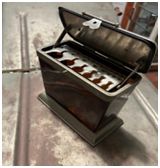
The "sterilizer"
The Treaty of Versailles was humiliating punishment after Germany lost WW1. The German population longed for salvation, and all drugs became available including morphine, cocaine and methamphetamine (Pervitin). The latter became the "Volksdroge". However, the Nazis hated drugs and wanted to be drugs themselves, promising salvation and hence Hitler became the "Drug".
There is a great paucity on Hitler's drug dependency in publish works about him. Joachim Fest's 900-page biography mentioned his "narcotic trance" and "fatal drug dependency" but remains unexplained.
Cover of Fest's biography
Hitler became "Drug-addicted from 1936 and this dependency can be divided in 4 phases.The first one was IV vitamins from 1936-1941. The second phase started in the fall of 1941 with opiate and hormone injections. Then in 1941-1943 the third phase was the heavy opiate period. The fourth phase was at the end of 1944 when drugs became virtually unobtainable and madness and withdrawal ensued. These drugs were provided to Hitler by his personal physician, Dr Theodor Morrel from 1936-1945.
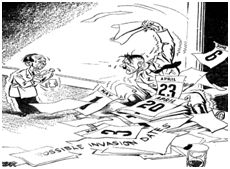
Contemporary cartoon
"It's a good thing you're here, doctor. This cocaine is wonderful. I'm glad you found the right remedy to free me from these headaches again for a while."
He received over 70 different drugs for 9 years which significantly contributed to his overconfidence and poor decision making, impaired judgement and paranoia, declining health and erratic decision making and finally his delusional ideas about Germany's victory. His drug addiction accelerated the downfall of Nazi Germany. Drugs became "Apples from Hesperides" for him.
Drugs and Hitler's decisions can be summarised in 9 decisive acts
1. Capitulation of Czechoslovakia 15th May 1939. He convinced President Emil Hache to sign a piece of paper and sealed the fate of the country. The next day Germany invaded the Czech Republic without a shot been fired.
2. Stimulant decree 1940. He ordered the free availability to German troops of methamphetamines (Pervitin) which fuelled the German "Blitzkrieg". "A sleeping soldier is a useless soldier, incapable of action". Millions of pills were distributed and freely available to the troops.
3. Blitzkrieg. He was afraid that the Prussian General staff was too successful as German tanks covered 240 miles in 11 days, overcome the Ardennes forest and bypassing British and French troops during the invasion of France. He halted the "Blitzkrieg and disempowered the military leadership. After all it was his war.
4. Dunkirk, German land forces stopped for 10 days. Through the "Sickle-Cut" 340 000 Frence, British and Belgium troops were encircled and retreated to Dunkirk in Northen France. Goring (a morphine addict) convinced Hitler that the Luftwaffe and not the Wehrmacht's Prussian Aristocrats could deliver the glorious victory. Hence Hitler, though the "Führer principle" at 12.45 May 24, 1940, stopped the German panzer divisions from advancing towards Dunkirk for 10 days until 4 June 1940. This allowed Operation Dynamo (May 26-June 4, 1940) to successfully evacuated all but 90 000 Frence troops. General Manstein entered a destroyed Dunkirk at 9.40 the morning of the 4th June. This "Halt Order" changed the outcome of WW2. Had Hitler not stopped the attack; England would have lost all their trained soldiers (General Edmund Ironside) and most likely the war.
5. Stalingrad instead of Moscow (Case Blue) August 1941. By now Hitler was a regular user of opiates (Eukodal) and Methamphetamine (Pervitin) which is an addictive psychostimulant, with rapid physical dependency and serious long term complications including insomnia, memory loss, anxiety, mood disturbances, psychosis and decreased cognitive functions.
Operation Barbarossa (August 1941) was a great strategic blunder. There was a serious conflict between Hitler and the General Staff. The Generals wanted to enter Moscow and end the war, while Hitler decided to divide the troops to conquer Stalingrad in the North and the oilfields in the Caucuses and Iran in the South. The army leadership warned of possible defeat, but Hitler had a fanatical resistance to advice.
6. Slowly the National Socialist Reign of terror poisoned itself from within. Between 1941 and 1944 medications were recorded >1 100 times, 28 different pills daily and more than 1000 injections in 800 days. He was obviously drug dependant. The drug Eukodal (Oxycodon, an opiate) became the buffer between Hitler and the world and had a profound influence on all his decicions especially after 1942. Opioids and Methamphetamine became his life-lines to function.
Examples of the drugs he used
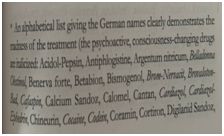
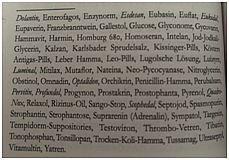
Lists of drug names
7. Mussolini 1943. Hitler, artificially pepped up by Dr Morell, met the leader of Italy and convinced him not to surrender while Rome has been bombed. Another drug induced decision that contributed to the final destruction of Italy.
8. Wolfsschanze 1941-1944. This was Hitler's Bunker in the Masurian lake district of Poland. He survived the attempt on his life. Here he holed up for weeks in the bunker as the fronts were closing in from all sides. He worked, slept and vegetated there in total isolation with a pharmacological barrier around him provided by Theodore Morell.
D-Day ,6 June 1944 found Hitler was in East Prussia and responded late to the invasion. By this time, he was a complete drug addict with impaired functions but with a fanatical self-belief.
"Here, in the bunker the needle remorselessly penetrated his ruined veins, the plunger was pulled back, the stuff shot into the veins and again and again he escaped into self-delusion". The total irony of his drug addiction was that he denied the effects it had on him. In 1944 he quoted "You must be healthy; you must stay away from which poisons your body. We need a sober people. In the future the German will be judged by the works of his mind and the strength of his health."
9. Final Phase 1945. Hitler, now in a destructive phase of withdrawal, as there were no more drugs of happiness, stated that "I will leave all the men of history behind me. I want to be the greatest, even if the whole German people perishes in the process". He then ordered the complete destruction of German infrastructure through the "NeroDecree", March 19th, 1945.
Germany lost the WW2 for various reasons. There was military overreach, many strategic errors, economic limitations, Allied industrial power, failure of the Nazi leadership, the chemical stimulants and Hitler's drug addiction.
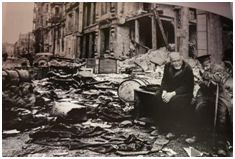
Two elderly German men in the rubble of a street in May 1945